
Today marks the 161th anniversary of the original Juneteenth. This is an important date to continue to mark because it brings forth an important reminder: freedom did not arrive all at once. The end of slavery and the realization of freedom were separated by time, systems, information, and power. Justice today, like in the past, is not a single event. It is an ongoing process of creating conditions where people can fully participate and thrive. This lesson extends beyond history into our organizations today.
Beyond Outcomes
As part of normal operations, organizations often focus on establishing the right pay structure, having a meaningful awards program, measuring performance, promoting the right people and more. Some organizations choose to evaluate these policies by focusing on the impact on their bottom line. From my experience, this process involves asking questions like: Who got promoted? Who got the raise? Who got into a leadership program? Did that impact the P&L statement? Did personnel processes cause undue hardship to revenue-producing metrics?
While these questions matter, they are only a fraction of the impact story.
Because, as organizations think about and evaluate their policies, employees are conducting their own assessments. And their experiences are not about impacts to the bottom line, they are about fairness. In other words, justice.
What Organizational Justice Means
To understand what employees experience as fairness, we need to look beyond outcomes.
Research on organizational justice has consistently shown that employees perceive fairness through four distinct lenses. Each lens is a reflection of different dimensions of an individual’s experience and perception, and each lens can be summarized with one key question.
Who Got What?
The first dimension is about the relationship between inputs and outcomes. People are social comparison animals. We naturally look around and compare ourselves to others. At work, people tend to look at their efforts and their rewards, and compare themselves to others – and compare others to others too. Did a colleague get a promotion when you both have the same history? Did someone get a raise when you both contributed to the same projects? Did the superstar get passed for a leadership position? Did the underperforming individual contributor get selected for a prestigious development program?
Researchers call this Distributive Justice. It is about the fairness of outcomes as they are distributed across the organization. The key question to ask is “who got what?”
How Was That Determined?
The second dimension is about how the decision-making process that decides on the outcomes works. As people compare and contrast differences in outcomes, they tend to also think about the process that led to those outcomes. We see this in people’s curiosity about behind-the-scenes processes. How did the committee select participants? How did the manager determine who got a raise? How was the superstar not selected? How were bonuses determined?
This is called Procedural Justice. It is about the fairness of the process or procedures by which outcomes are allotted. The key question to ask is “how was that determined?”
Was Information Accessible and Available?
The third dimension is about what we know. Particularly, what we know about the decisions that impact our lives at work. People want to have truthful justification for the decisions that affect them. And when I say “have” I mean available and accessible to them, not in an obscure unlinked, unpublished, unadvertised page somewhere on the intranet. We see this when employees inevitably ask for explanations. Why is a reorganization needed? Why is our unit changing? Why is the other team being kept and we are laid off?
This is called Informational Justice. It is about receiving truthful, accessible information about decisions that impact their work. The key question to ask is “was information accessible and available?”
Were People Treated with Dignity and Respect ?
The last dimension is about how we are treated. At work, we all have a sense of how we are treated. And naturally, how our treatment compares to others. Was I not given the benefit of the doubt but my colleague was? Were my ideas dismissed but my colleagues were not? Did I experience harassment or bullying? Was I dehumanized?
This is called Interpersonal Justice. It is about being treated well. The key question to ask is “Were people treated with dignity and respect?”
Why Justice Matters
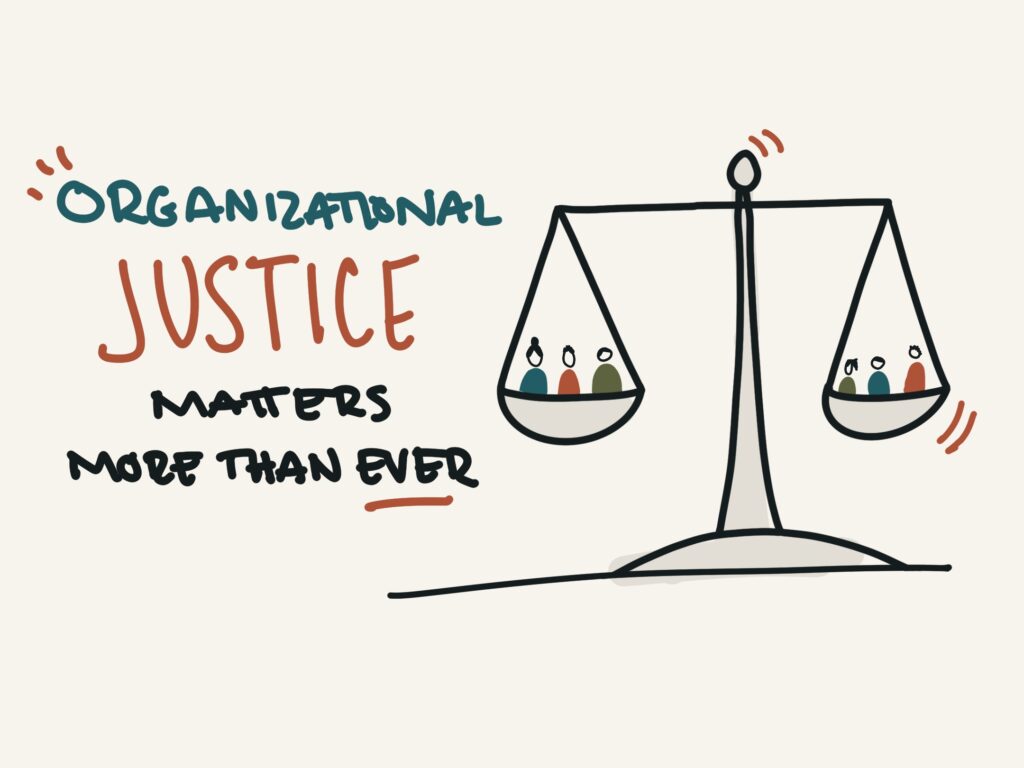
These four dimensions lead to one conclusion: Justice is not one thing. It is a collection of experiences that shape how people understand the systems that make up their organizational lives. There is a conception that justice is strictly a moral issue. But it is also a performance issue, one that impacts organizations as a whole.
Research has consistently shown that perceptions of unfairness undermine motivation and increase behavior that can damage organizational effectiveness. When an employee believes they are being treated unfairly, they become more likely to disengage, withdraw effort, and seek employment opportunities elsewhere. At the same time, fairness is one of the foundational elements of high-performing teams. It is one of the mechanisms that creates the conditions that lead employees to give their discretionary effort. And discretionary effort is where organizations build their competitive advantage.
Why Justice Matters Now More Than Ever
Justice is not a single event, a training, or a holiday post. It is a leadership practice. It requires consistently showing up, asking questions of the systems that shape our employee’s experiences at work.
It is also about understanding the context in which the organization exists. What happens in the world outside the organization very much impacts what happens within it. Layoffs across the industry, narratives about the importance of the work people do, generalizations about a group of people – they all shape the organizational context and therefore an individual’s experience.
Justice is felt by everyone, everywhere, all the time. And, in organizations, research gives us four powerful questions to interrogate the systems that shape hiring decisions, performance reviews, developmental opportunities, layoffs, and even everyday interactions. That is, the systems that people move through within the workplace.
Organizations do not become just because they say they value justice. They become just through repeated choices and practices.
The Work Is Ongoing
Juneteenth reminds us that justice is never fully complete. It requires consistent attention, reflection, and action. For leaders, the question is not “Does justice matter?” The question should be “How do people in our organization experience fairness?” and “How can I help shape systems so they are just?”
As a human-first, researched-informed organization, Strategy Doula™ is positioned to help leaders tackle organizational justice, not something to commemorate, but rather, as something that leaders practice.