
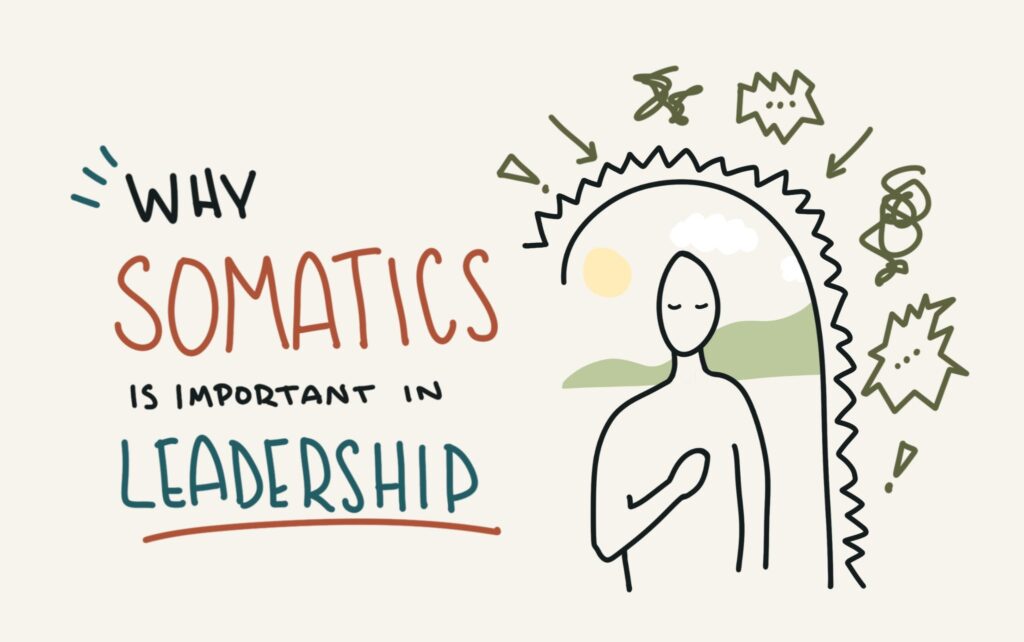
Over the last several weeks, our conversations with leaders have revealed an interesting truth: the word “somatics” is not part of their leadership toolbox – sometimes, it is not even part of their vocabulary. Yet, it is a foundational element of our experience at work.
What is Somatics?
Before we talk about the importance of somatics in the workplace, let’s first establish what we mean by somatics.
Somatics is simply awareness of the body: how we hold tension, where we store emotion, and how we release them. The key idea is that our bodies are more than just the vessels for our minds. Our bodies actively shape how we think, feel, and process our experiences.
Why Somatics Matter at Work
Imagine this: you wake up in a great mood, your morning routine was super smooth, the commute was a dream, the coffee was particularly good, and everything clicked into place. Basically, you were in flow. Can you imagine how this feels in your body? Do you feel light? Is there any tension anywhere?
Now imagine this: During your commute to work this morning you hit terrible traffic. The stoplight has now changed three times and you have not moved an inch. When you finally start to move again, someone cuts you off. By the time you arrive at work, you are running behind. The pot of coffee is empty, and you did not get to put your things down before you were pulled into a series of meetings. Do you feel frustrated? Is there tension in your body? Are you clenching your jaw or furrowing your brow?
Finally, think about how you might show up at work if you had the easy morning. Are you relaxed? Is it just a little easier to find patience? Now, how would that change if you had the difficult commute? Do you feel a bit snippy? Are normal things irritating you more than usual? For most people, the answer is yes. A bad commute can make them more irritable, and a good and easy morning brings more ease into their days. While these examples show how our body shapes our experiences at work, they also show that we have an opportunity to address it.
Research about Somatics at Work
A growing body of research shows that the physiological state you bring into work changes how you perceive, interpret, and respond to workplace situations. Essentially, rather than relying just on reasoning, people continuously integrate physiological cues that influence attention, emotional regulation, interpersonal behavior, and decisions making. For example, a recent article showed how employees who experience greater physiological stress before arriving to work are more likely to engage in interpersonal counterproductive work behaviors during the work day (Gale et al., 2026). Similarly, other research has found that affective states (moods or emotions) influence employee’s judgements, behaviors, and workplace relationships (Barsade & Gibson, 2007), while physiological and emotional self-regulation contribute to more effective leadership and work performance (Beal et al. 2005).
Taken together, this body of research suggests that leadership effectiveness is not only determined by knowledge or intention. It is also shaped by the physiological conditions under which people think, feel, and interact. Leaders who recognize and support healthy regulation can create conditions that improve collaboration, decision quality, and organizational performance.
Evidence-Based, Research Informed Solutions
The good news is that physiology is not fixed. Researchers have identified how some small practices can help people “reset.” For example, Gale et al. identified that listening to relaxing music is a small but effective practice that can interrupt the carryover effects from commute stress. This in turn reduces the likelihood that commute frustration becomes interpersonal conflict.Other researchers have identified how routines like quiet time, walking, reading, and listening to music before work can help improve affect, energy, and work engagement (Sonnetag 2003). And still others have identified micro-practices (e.g. quiet reflection, stretching, deep breathing) can be implemented throughout the day to help employees recover from work demands (Kim et. al 2026).
Taken together, these findings suggest that preparing and resetting the nervous system throughout the day may improve not only individual well-being but also the quality of workplace interactions and performance.
The Strategy Doula Approach
At Strategy Doula, we recognize that leadership begins before you arrive at work. In particular, we know the importance our bodies play in how we show up at work – for ourselves and the people we lead. This is why all our programs begin with personal grounding and incorporate somatics. Learning how to take moments to regulate yourself can lead to better outcomes for people and the organization as a whole.
Apply this Today
The Email Reset
Next time you get a stressful email, instead of responding right away, take three deep breaths. Inhale slowly for a count of 4 seconds, hold for 4 seconds, exhale for 4 seconds and hold for 4 seconds. This is called box breathing. It can help interrupt your initial reaction to the email and allow you the space to respond with a clear mind.