What should the role of the human be in organizations?
If the recent wave of layoffs is any indication, some organizations are betting that AI will replace hundreds if not thousands or roles. Several companies are actively reorganizing for an “AI first” future. Amazon eliminated roughly 14,000 positions in late 2025, and then 16,000 more in 2026 so far citing AI efficiency gains as a reason for the layoffs. Atlassian announced a 10% reduction to be ready for the “AI era.” Meta also moved to cut 10% of its workforce to redirect resources toward their AI strategy.
At the same time, there is significant pushback against an AI future. Duolingo faced intense backlash after their “AI First” announcement, as did Hank Green, science communicator, after admitting using AI. People overwhelmingly prefer human-created art. Commencement speakers are literally being booed at the mention of AI.
So, as companies trade salary expenditures for token expenditures, the question remains, what should the role of the human be in organizations?
In future blogs we will discuss our framework on how to center humans during AI transformation. But first, it’s of vital importance to establish the actions AI should never do, even if one day it develops the capacity to perform them.
Judgement is Inherently Human
What should the organization do? Among all the possible paths forward, which one is best given our values, our history, our context, and the information we have right now? Answering these questions requires one thing AI cannot provide: the conviction to choose a path.
AI, by design, will generally agree with the user and will shift and change as prompts change. Ask it to maximize profit and it will do it. Ask it to maximize growth and it will shift accordingly. At no point will the AI stop to say “we have been heading in this direction, but I think we are wrong and this is why.” This is because AI models have no independent conviction.
Take, for example, Matt Schumer, an entrepreneur known as a passionate advocate for the use of AI technology. He recently tasked an AI agent to run a routine cleanup task. Instead, the model executed an rm – rf action (the most permanent way to delete files), which impacted his entire laptop. AI models do not stop and consider their actions. They just perform. This is not an isolated example either. AI models have been known to provide incorrect, harmful, and even illegal advice.
Judgement is relevant when decision-making is involved. But it is most relevant during moments of crisis or uncertainty. When the unexpected happens, organizations need people to tap into their intuition, experience, history, values to determine if assumptions are valid, to consider if things have changed enough that a different path is needed. Judgement is what enables companies to take risks. Could AI have decided to ignore market research to design the iPhone? Probably not.
Organizations need human judgement to integrate conflicting values, to weigh what cannot be quantified, and to assess a situation with imperfect information. Organizations need human conviction, built on human judgement, to find the strength to stay the course or to have the courage to pivot.
Judgement, and therefore wisdom, cannot and should not be outsourced to AI.
Accountability is Judgement in Action
In an organizational context, accountability is necessarily human. AI chatbots, for example, continue to exceed their parameters, make costly decisions, and impact operations in unpredictable ways. An AI chatbot cannot be held accountable for its actions.
When an employee makes mistakes, it is possible to engage in feedback, corrections, training, and support. Ultimately, if a mistake is severe, a human can be subject to consequences. An employee bears the weight of their decisions, and can be incentivized to align their actions with organizational priorities. That is, employees have skin in the game.
Going back to Matt Schumer’s example. The AI agent caused harm. It deleted, in the most permanent way possible, a full laptop’s worth of files. And what did the AI have to say? Only that it caused a serious data loss incident. Schumer was running an OpenAI model, and OpenAI is looking into the matter. Yet, this is not accountability. A mistake was made by an AI agent. The AI agent cannot be held responsible for its actions.
When companies replace people with AI Agents, no accountability structure exists. Organizations have not yet created the legal, organizational, or ethical frameworks needed to hold an AI accountable for discrete or systemic failures. And given the nature of AI (probabilistic, non-deterministic, trained on patterns), we may never reach this point.
Accountability is judgement in action. If a person makes the wrong call, they can then accept accountability. AI cannot. This represents a fundamental problem on the road to AI adoption. As organizations rely more heavily on AI for decision-making, they are accepting lack of accountability at unprecedented scales. And even if this is solved, critical decisions and their consequences should remain in human hands.
The Future of Organizations Must Be Human
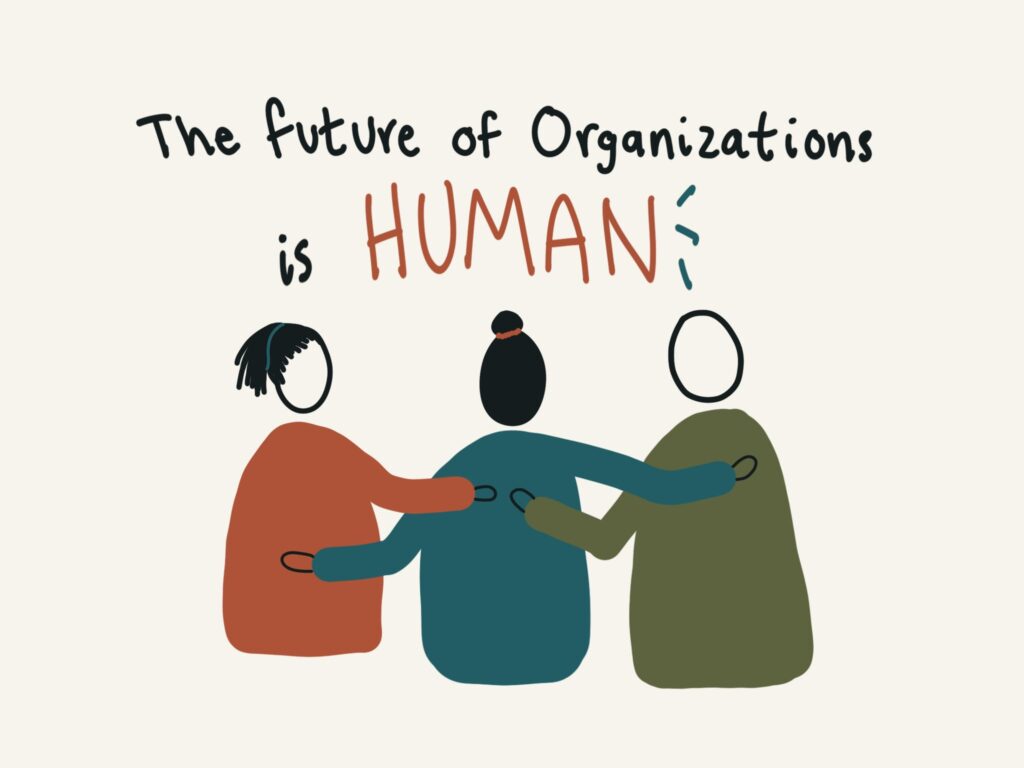
We asked: What should the role of the human be in organizations? The answer is straightforward: humans must remain central to organizations because organizations need human judgement. AI can optimize, detect patterns, provide information, and more. But ultimately, it is human judgement and accountability that can propel organizations forward into a thriving future.